
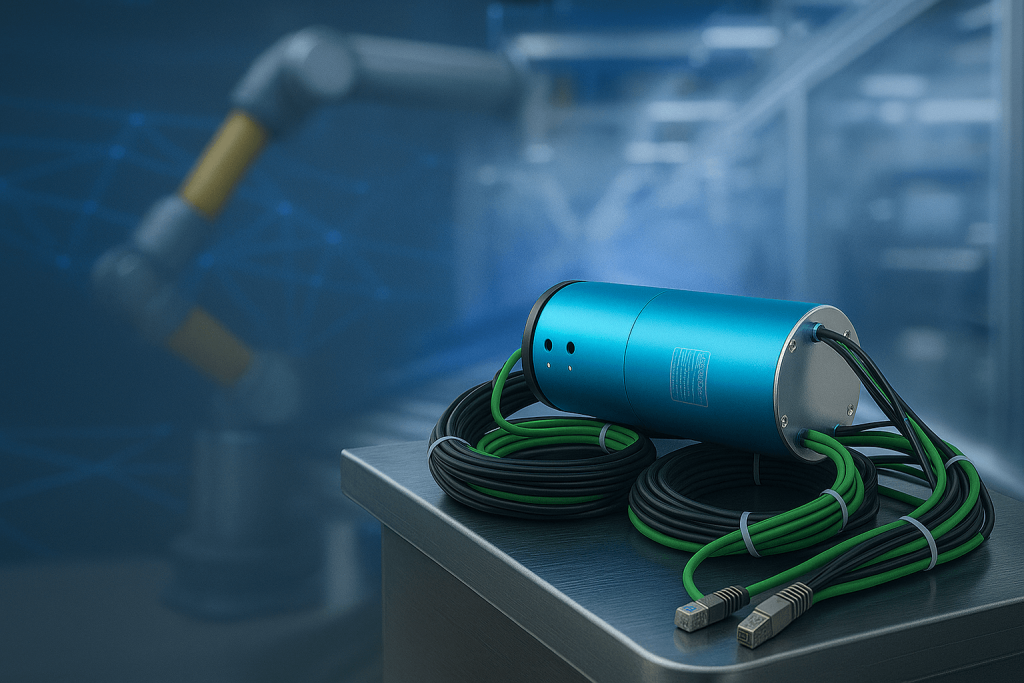
How Slip Rings Work in Robotics Automation: Ensuring Continuous Power and Signal Transmission
Introduction
Robotics automation increasingly demands components that provide both agility and reliability. When a robot joint needs to rotate freely while carrying power and sensitive signals — from motor power to encoder feedback or camera video — engineers rely on slip rings to create a robust rotary interface. In this article we’ll explain how slip rings function in robotic systems, the different types used, selection criteria, common problems and maintenance tips, and real-world recommendations for choosing the right unit.
What Is a Slip Ring?
At the simplest level, a slip ring is an electrical rotary connector: a set of conductive rings attached to the rotating assembly and stationary brushes that slide on those rings. As the rotor turns, brushes maintain a physical contact with rings so power and signals can pass continuously from the fixed frame to the rotating part. This avoids cable twisting and enables continuous 360° rotation — a vital capability in many robotic applications.
Why Robots Need Slip Rings
Robotic arms, pan-tilt cameras, rotary scanners and many automated machines need unlimited rotation without limiting wiring. Without slip rings, cables would twist, reduce reliability, and eventually fail. Slip rings remove that limitation by acting as the rotating “pass-through” for electricity and data. They enable permanent electrical continuity and are especially important in robots performing continuous or repetitive rotational motions — for example welding manipulators, packaging heads, or inspection turrets.
How Slip Rings Work Inside Robotic Joints
Mechanically, a slip ring assembly consists of concentric conductive rings mounted on the rotor and matching stationary brushes or contacts on the stator. Each ring corresponds to an independent circuit (power, ground, signal). Brushes — manufactured from carbon-graphite, metal-graphite, or precious-metal alloys — press against rings with controlled preload to ensure stable contact while minimizing wear and electrical noise. Advanced designs use spring-loaded contacts, gold plating, or precious metal contacts when low contact resistance and long life are required.
In practice, a robotic joint may use multiple circuits through a single slip ring: motor power, encoder feedback, thermocouple signals, camera video, or CANbus lines. Hybrid assemblies can also include pneumatic or hydraulic channels, making them a compact multi-media solution for sophisticated robots. See our hybrid option: Hybrid Slip Ring.
Common Slip Ring Types Used in Robotics
Engineers choose slip ring types based on space, channel count, data speed requirements, and environmental needs. Typical options include:
- Capsule / Miniature Slip Rings: Small, compact — fit into tight joints for light-duty robots.
- Through-bore Slip Rings: Offer a central hollow bore for routing cables, fluids or shafts — ideal for robot arms. (See Through Bore Slip Ring.)
- Hybrid Slip Rings: Combine electrical channels with pneumatic/hydraulic paths or fiber optics for multi-media transmission.
- Ethernet / High-Speed Slip Rings: Designed for reliable high-bandwidth data (Ethernet, HD-SDI) across rotation. (See Ethernet Slip Ring.)
- Servo Encoder Slip Rings: Engineered for low-noise encoder feedback and precise motion control. (See Servo Encoder Slip Rings.)
- Custom Slip Rings: Tailored designs for unique robots or extreme environments. (See Custom Slip Ring.)
Key Benefits for Robotic Systems
Slip rings deliver several valuable benefits in robotic automation:
- Unlimited rotation — eliminates cable twist and extends cable life.
- Consolidated wiring — centralizes power and signal channels, simplifying integration.
- Signal integrity — modern slip rings support high-speed data with low noise when properly specified.
- Lower downtime — modular brush cartridges and replaceable parts make maintenance fast.
- Multi-media capability — hybrid designs can carry electrical, optical, and pneumatic media in one package.
Design Considerations: What Engineers Must Specify
Selecting the right slip ring requires careful attention to your robot’s technical requirements. Key parameters include:
- Number of circuits: How many power, ground, and signal lines are needed?
- Current and voltage per channel: Continuous and peak requirements.
- Data rates: Ethernet, CANbus, encoder resolutions — verify required bandwidth and error rates.
- Rotational speed: Match or exceed maximum RPMs of the joint to avoid wear and overheating.
- Environmental rating: IP level, temperature range, and corrosion resistance for the operating environment.
- Space & mounting: Outer diameter, through-bore size, and flange options for integration.
Installation Best Practices
Proper installation maximizes performance and lifetime. Important practices include:
- Ensure concentric mounting and correct axial clearance to avoid runout and uneven brush wear.
- Secure cable strain relief to prevent mechanical stress on termination points.
- Follow manufacturer torque specs for terminals and mounting bolts.
- Set brush preload per vendor instructions — incorrect preload causes noise or accelerated wear.
- Balance rotating assemblies where high RPMs are involved to reduce mechanical vibration.
Maintenance Strategies
With predictable maintenance, slip rings can last many millions of revolutions. Recommended strategies:
- Inspect brushes and rings periodically (visual and electrical checks every 3–6 months depending on duty cycle).
- Measure contact resistance on critical low-ohm circuits to detect early degradation.
- Clean ring surfaces with manufacturer-approved solvents to remove dust and conductive debris.
- Keep spare brush cartridges and terminal kits on hand for fast replacement.
- Use condition monitoring (temperature sensors, resistance logging) for mission-critical robotics.
Typical Failure Modes & Troubleshooting
Common faults include increased contact resistance, electrical noise on data channels, arcing, and mechanical wear. Troubleshooting steps:
- Perform a visual inspection for contamination or scoring on rings.
- Check insulation resistance between circuits using a megger.
- Measure contact resistance with a 4-wire method for precision.
- Use thermal imaging under load to find hotspots indicating poor contacts or overload.
- Replace worn brushes and re-test under normal operating conditions.
Case Study — Robotic Weld Cell Integration (Practical Example)
In a high-throughput welding cell, engineers installed a through-bore slip ring at the robot’s wrist to pass power, ground, and high-speed encoder signals without cable twisting. By specifying a slip ring with gold-plated signal rings and larger power tracks, the system maintained stable encoder feedback and reliable power delivery under continuous 24/7 operation. Routine brush inspection and pre-scheduled cartridge replacement reduced downtime and improved throughput.
Summary Table: Matching Slip Ring Types to Robotics Use Cases
| Use Case | Recommended Slip Ring Type | Key Reason |
|---|---|---|
| Compact articulated robot | Capsule Slip Ring | Small footprint, low weight |
| Wrist-mounted sensors & cameras | Through-Bore Slip Ring | Central hole for cabling, clean routing |
| High-data vision systems | Ethernet Slip Ring | Reliable, low-jitter data links |
| Multi-media tool changer | Hybrid Slip Ring | Power + pneumatic + signal in one unit |
| Precision servo joints | Servo Encoder Slip Rings | Low electrical noise, precise feedback |
Frequently Asked Questions (FAQ)
1. What is the difference between through-bore and capsule slip rings?
Through-bore slip rings include a central hollow shaft for routing cables or shafts — ideal for robot wrists. Capsule slip rings are smaller and suitable for constrained spaces.
2. Can a slip ring carry Ethernet and power simultaneously?
Yes — hybrid and Ethernet-rated slip rings are designed to carry both power and high-speed data channels with proper shielding and channel separation.
3. How often should brushes be replaced in a robot application?
Replacement intervals depend on duty cycle and environment; a practical schedule is a visual check every 3 months and a planned replacement every 6–18 months based on wear data.
4. Are there slip rings designed for clean-room or medical robots?
Yes. Medical and clean-room applications use specialized materials and seals to minimize particle generation and comply with hygiene standards.
5. Can I retrofit a slip ring into an existing robot?
Often yes — but engineering validation is necessary to confirm space, mounting, electrical compatibility, and balancing requirements.
Conclusion
Slip rings are fundamental enablers of modern robotic automation. They remove mechanical wiring constraints, enable continuous rotation, and, when correctly specified, maintain high signal integrity and long service life. Whether your system needs compact capsule rings for joint-level integration or hybrid assemblies that combine pneumatic and electrical paths, selecting the right slip ring and maintaining it properly are keys to reliable robotic performance.
Related product pages: Through Bore Slip Ring · Hybrid Slip Ring · Servo Encoder Slip Rings · Custom Slip Ring · Pneumatic Slip Ring · Ethernet Slip Ring.