

Modern manufacturing relies heavily on CNC machining centers to produce high-precision parts efficiently. Whether in aerospace, automotive, or medical industries, machining centers must operate continuously while maintaining accuracy and reliability.
However, one challenge that often goes unnoticed is how to deliver coolant, air, or hydraulic oil to rotating spindles at high speed. Without a proper solution, leaks, overheating, and spindle damage can occur.
This is where high-speed rotary unions become essential components. They enable fluid transfer between stationary and rotating parts, allowing CNC machines to run at high RPM while maintaining stable cooling and lubrication.
The Cooling Challenge in High-Speed CNC Spindles
During high-speed machining, the cutting tool generates significant heat due to friction between the tool and the workpiece. If heat is not removed quickly, several problems can occur.
First, excessive heat can reduce tool life dramatically. Tools may wear out faster or even break during operation. Second, overheating can affect machining accuracy, causing dimensional errors in finished parts.
Additionally, high temperatures may damage spindle bearings and internal components. In modern CNC machining centers running at 10,000–30,000 RPM, thermal management is absolutely critical.
Therefore, coolant delivery directly through the spindle has become a standard solution. But delivering coolant into a rotating spindle requires a reliable interface — and this is exactly the role of a rotary union.
What is a High-Speed Rotary Union?
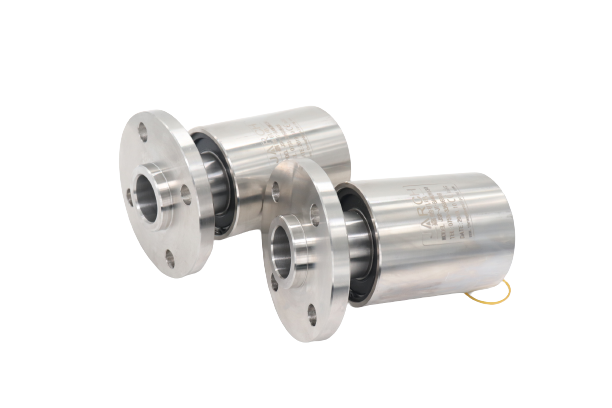
A high-speed rotary union is a mechanical device designed to transfer fluid (coolant, oil, air, or hydraulic fluid) from a stationary source into a rotating shaft.
It creates a sealed connection between stationary piping and rotating components, allowing continuous fluid flow even while the spindle rotates at high speed.
In CNC machining centers, rotary unions are typically installed at the rear of the spindle. Coolant flows through the rotary union and enters the spindle shaft, eventually reaching the cutting tool through internal channels.
This design allows through-tool coolant delivery, which significantly improves cooling efficiency and chip evacuation during machining.
In many advanced systems, rotary unions are also integrated with electrical slip rings when both fluid and electrical signals need to be transmitted simultaneously. For example, some automated machines combine rotary unions with hybrid solutions like https://slipringsupplier.com/hybrid-slip-ring/ to handle complex rotary interfaces.
Key Benefits of High-Speed Rotary Unions in CNC Machines
1. Improved Cooling Efficiency
One of the biggest advantages of high-speed rotary unions is the ability to deliver coolant directly to the cutting edge.
Instead of spraying coolant externally, through-spindle coolant flows precisely to the tool tip. This dramatically improves heat removal during cutting operations.
Better cooling leads to longer tool life and more stable machining performance, especially when working with difficult materials like titanium or hardened steel.
2. Higher Machining Speeds
Efficient cooling allows CNC machines to operate at higher cutting speeds. When heat is effectively controlled, operators can increase spindle speed and feed rates without damaging the tool.
This results in shorter machining cycles and higher productivity.
In modern manufacturing environments where efficiency matters, this advantage can significantly improve overall production output.
3. Better Chip Evacuation
Another critical benefit is improved chip removal.
When coolant is delivered through the spindle directly to the cutting area, it helps flush chips away from the cutting zone. This prevents chips from accumulating around the tool, which can otherwise cause tool damage or poor surface finish.
For deep hole drilling or complex cavity machining, through-tool coolant enabled by rotary unions becomes especially important.
4. Enhanced Machine Reliability
High-quality rotary unions are designed to handle high RPM and pressure while maintaining reliable sealing performance.
Advanced sealing technologies reduce leakage and minimize wear over time. This ensures stable operation even in demanding machining conditions.
Reliable coolant delivery also protects the spindle from overheating, which helps extend the lifespan of expensive spindle assemblies.

Integration with Other Rotary Transmission Technologies
In many automated machining systems, fluid transfer alone is not enough. Machines may also require electrical power, signal transmission, or pneumatic control through rotating interfaces.
For example, robotic tooling systems or rotary indexing tables may combine rotary unions with electrical slip rings.
In such cases, integrated solutions become highly valuable. Engineers often use combinations such as:
Hydraulic rotary unions for coolant or oil delivery
Pneumatic rotary unions for compressed air control
Electrical slip rings for signal and power transmission
For fluid-based applications, engineers commonly choose Hydraulic rotary unions
When machines require customized interfaces or multiple channels, manufacturers may design specialized solutions through Custom slip ring to integrate electrical and fluid transmission in one compact assembly.
Typical Applications in CNC Machining Centers
High-speed rotary unions are widely used across different types of CNC equipment.
Some common applications include:
Vertical Machining Centers (VMC)
These machines often rely on through-spindle coolant to improve drilling and milling efficiency.
Horizontal Machining Centers (HMC)
Due to deeper cutting operations, coolant delivery through the spindle is essential for chip evacuation.
CNC Turning Centers
Rotary unions can deliver coolant to live tooling systems or rotating spindles.
Deep Hole Drilling Machines
These machines require high-pressure coolant delivery directly through the tool.
In all these cases, the rotary union ensures stable fluid transmission while the spindle rotates at high speed.
Key Factors When Selecting a High-Speed Rotary Union
Choosing the correct rotary union is important for machine reliability and performance.
Engineers typically evaluate several key parameters:
| Parameter | Description |
|---|---|
| Maximum RPM | Must match or exceed spindle speed |
| Fluid Type | Coolant, oil, air, or hydraulic fluid |
| Pressure Rating | Determines coolant delivery capability |
| Number of Passages | Single or multi-channel fluid paths |
| Seal Technology | Affects lifespan and leakage prevention |
Proper selection ensures long-term reliability and optimal machining performance.

Summary: Why Rotary Unions Matter in CNC Machining
| Key Benefit | Impact on CNC Machining |
|---|---|
| Through-tool coolant delivery | Better heat removal |
| Higher machining speed | Increased productivity |
| Improved chip evacuation | Cleaner cutting area |
| Spindle protection | Longer machine lifespan |
| Integrated fluid transfer | Supports complex automation |
Conclusion
High-speed rotary unions play a crucial role in modern CNC machining centers. They enable efficient coolant delivery to rotating spindles, ensuring stable thermal control during high-speed cutting operations.
By improving cooling efficiency, chip removal, and machine reliability, rotary unions directly contribute to higher productivity and better machining quality.
As CNC machines become more advanced and automated, the integration of fluid transfer technologies with electrical transmission systems will become increasingly common. Solutions that combine rotary unions with slip rings or customized rotary interfaces will continue to support the evolving needs of smart manufacturing.
For engineers designing next-generation machining systems, selecting the right rotary union is not just a technical detail — it is a key factor in achieving reliable and efficient machine performance.
FAQ
What is a high-speed rotary union in CNC machining?
A high-speed rotary union allows coolant, oil, or air to flow between stationary pipelines and rotating CNC spindles while the machine is operating at high speed.
Why do CNC machining centers require high-speed rotary unions?
Because modern CNC spindles rotate at very high speeds, rotary unions ensure stable coolant delivery without leaks or pressure loss.
What happens if a CNC machine uses a low-quality rotary union?
Low-quality rotary unions may cause coolant leakage, unstable pressure, seal failure, and unexpected machine downtime.
What factors should be considered when selecting a high-speed rotary union?
Important factors include rotation speed, pressure rating, fluid type, seal materials, and installation space.
Can rotary unions work together with slip rings?
Yes. Rotary unions transfer fluids, while slip rings transmit electrical power and signals in rotating systems.